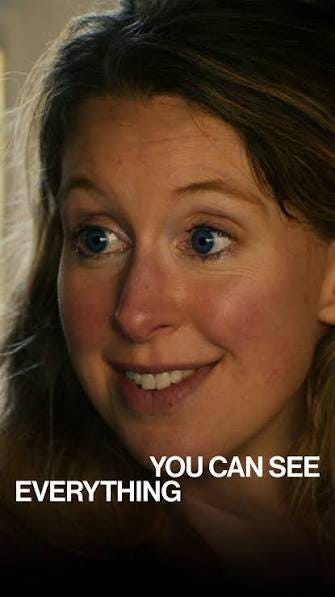
Every once in a while, there is a movie that’s an event. In the summer it was The Odyssey. Now it is the documentary You Can See Everything. So, of course, I went. To a packed showing on a weekday afternoon. It is about, I am sure you know, the convicted fraudster Elizabeth Holmes and is co-directed by Nathan Fielder and Lance Oppenheim. It is almost three hours long.
Fielder, I understand, is considered very cool though I admit I have never before seen any of his work. Still Holmes and her partner Billy Evans must have known about him because they invited Fielder and Oppenheim and their cameras into their home just 34 days before she went to prison for eleven years. She had been found guilty of defrauding her company Theranos investors out of millions.
Now I admit I have been intrigued by Holmes for years. I remember once being in a airport in 2014 killing time waiting for a plane. I went to the newsstand. You still went to newsstands in those days. I bought a copy of Fortune, not my regular magazine of choice, because it had this arresting portrait of a young woman on the cover with the headline: “This CEO is Out For Blood.” It was the height of Elizabeth’s fame as America’s youngest female billionaire. A Stanford drop-out who had created a revolutionary high-tech way to test blood using just one drop. Whattagirl! I was impressed.
Yes, it was the time when she was getting a lot of coverage everywhere and Theranos was valued at around $9 billion. But the trouble is along with attention comes scrutiny. John Carreyrou of the Wall Street Journal started investigating the company and discovered that there was a lot less in that small vial of blood that Elizabeth liked to hold up in photos than she claimed. The journalists who had written about her so glowingly at first had been taken in. But then so were her investors including Rupert Murdoch, Larry Ellison, Henry Kissinger and George Schultz who one would think should have known better. But Elizabeth, at that time, with her big blue eyes, weirdly deep voice, and girlish demeanor was apparently quite a charmer. Especially to older men.
I remember one story that came out at the time. That originally Elizabeth had brought her one drop is enough idea to an older woman professor at Stanford who told her it couldn’t work. But did she listen? One would think that Murdoch or Ellison or one of their staffers might have checked on the potential viability of Theranos with a hematologist. But why bother? She was a very attractive Stanford drop-out and it was in the heady high-tech days when elite school drop-outs were proving old fogies wrong and making the biggest bucks.
Now one might wonder why Billy and Elizabeth, who, when the filming began in 2023 had a baby and a toddler, invited a camera crew into their home a month before she was going away for a long, long time. But it soon becomes clear—and it may be the only thing that is quite clear in the documentary— she wants you to feel sympathetic and to see her as a sweet possibly neurodivergent young mother, who is being torn away from her babies, and who did nothing much wrong. At least that is what she keeps trying to manipulate Fielder and subsequently you the viewer to believe. While at the same time Billy, her partner, appears to be manipulating her. And Fielder who keeps a variety of WTF expressions on his face throughout is trying to manipulate them both to tell the truth—what truth?—no easy task.
A lot of the film and indeed Holmes’ story struck me, as primarily about style. Which is often the surface way we see and think about most things today. Elizabeth in her youngest female billionaire ever days, was very pale, wore bright lipstick, blew out her hair or wore it back and dressed in Steve Jobs black turtleneck, black pants drag. She claimed she didn’t care a whit about fashion. She was too busy saving our health care system. Meghan McCain who met her at the time thought she was full of it because she was already toting a Birkin bag. Black, presumably.
Now she looks totally different. First of all, she’s Liz and she only wears brown, beige, or cream crewnecks. Her hair is usually busy mom messy and she is rosy. Really rosy, as if Jones Road’s Dusty Rose light reflecting balm was smeared on her cherubic cheeks, forehead and nose. The only thing the same are those lightly mascaraed enormous blue rarely blinking eyes. How does she do it? And she can cry without making a sound. Large perfectly formed tears seem to slide out of those clear unblinking unsmudged eyes down her rosy cheeks whenever Fielder asks her if she thinks she did anything wrong. It really is impressive.
And, oddly, since I have lousy eyes and am interested in eyes, the few times she puts on her glasses on her way to prison, her eyes become smaller and she starts blinking a lot. Just like the rest of us. What kind of contact lenses does she wear at all other times? And where can you get a pair? Now whoever manufactures those lenses is a company I would invest in.
What do you find out about Elizabeth during those three hours when you can presumably see everything? That she doesn’t understand why she is going to prison, that the device her company created can do all those tests – not did all those tests—that she has never told a lie, that she can’t stir eggs properly and that she does not understand Abbot and Costello’s Who’s On First routine. Allegedly super smart, she doesn’t get that Who is on First. Maybe.
Everyone in the documentary is performing. Elizabeth, of course, Billy, acting the villain, though that might be the role he and Liz agreed he should play. Fielder, WTF-ing it, even about his own feelings of sympathy and Amanda Seyfried who shows up in the second half are performing too. But, hell, she is an actress, anyway, who played Elizabeth before in a series and she plays her again.
Yes, that’s weird. But there are weird moments throughout. When Billy claims that Elizabeth after two years inside is “healthier.” Really? She is in the same facility as Ghislaine Maxwell. Wonder why they are both at a minimum-security prison camp? Or when Billy and Amanda start having a tussle over Charlie Kirk. Amanda was not a fan and created a social media storm with her criticism but Billy and presumably Elizabeth are. Are they now testing a MAGA-enthused pardon?
Yes, it’s all very confusing and quite watchable. Most critics have been very positive, and the documentary is already being touted as a best picture nominee. But for me the only truly honest moment in a movie that makes you question what honesty is happens when Liz and Billy are talking about recreating Theranos 2.0 and are tossing ideas back and forth with renewed enthusiasm. Holmes’ parents are in the room. The camera pans in on her mother’s face. Her expression isn’t WTF. It is far more troubled. You know what mom, at least for one, is really thinking; “Not again. Please, not again.” For her, I felt some sympathy.