
Local Girl Makes Good

Her name was Esther. It’s Purim. Pass the hamentaschen *
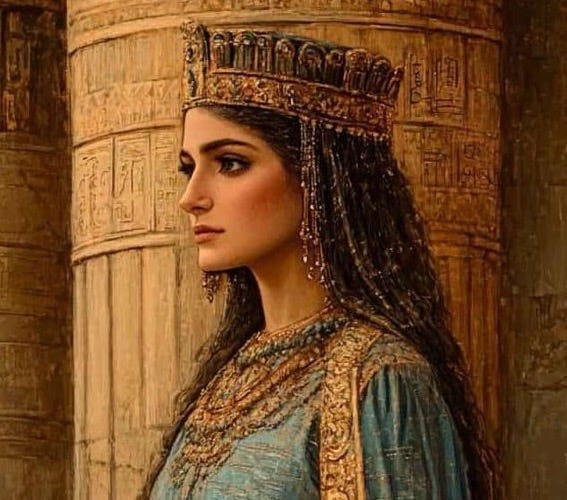
“She was a beauty contest winner who made the most important man in her world fall in love with her. She also had to keep her background a deep dark secret. (Shhh! She’s Jewish!) And there was an enemy, an antisemite, who wanted to destroy her and her people. Would she save them and save herself?”
Yes, the Book of Esther is a dramatic streaming series with a beautiful heroine in the leading role, and a plotline filled with dramatic twists and turns, set in an exotic time and place and yet still surprisingly relatable.
How do I know all this? Not because I’m religious. I in fact, I have only once been in a synagogue on Purim when the entire Book of Esther is read to the congregation. But I spent days last fall, reading and re-reading this most unusual Biblical text. That’s because I wrote a term paper about Esther for the first course in my doctorate program at Georgetown. In that five-month course you whizzed through a thousand years of important works from The Iliad to Aquinas. And though much of what I read was interesting and challenging, too, there was just so damn much misogyny. I was happy to find Esther, a rare woman center stage. And was surprised that her story still has such relevance.
Set in Persia, Esther is the only book in the Bible where God is not mentioned, where the Jews don’t long to return to Israel. They’re doing okay and Esther is a local girl from Shusan near the Palace who, when the opportunity arises, uses her beauty and charm to attract the King and become Queen. Dare I cite the immensely popular Catherine, Princess of Wales, the former Kate Middleton, commoner, as a contemporary example.
And as for the King, not exactly Prince Charming. The mighty ruler of the Persian Empire is portrayed as a man of great power and little moral strength. He turns personal slights into vengeful political actions, adores flattery, never thinks he is wrong and, by the way, loves to decorate with marble and gold. Does he sound a little bit familiar?
And this King has one very bad advisor named Haman, sort of the King’s id, who hates the Jews who live in the Kingdom because they’re different. He convinces the King that they all should be killed. No problem. The King, obediently, issues an Executive Order.
So, what’s Queen Esther going to do? Her Uncle Mordecai, who raised her, a minor official who hangs around the Palace, tells her she has got to save the Jews! But at first, she hesitates. He warns her she’s not safe, for when Jews are threatened even a Jew who has managed to pass, who may be important, will still be in danger.
But no, she still waits. She thinks, she plans and finally she uses her newly honed diplomatic and strategic skills to do what she must do. Exactly in her own way.
As one Biblical commentator and an Esther fan explains,” the distinctive feature in the portrait of Esther is change… She undergoes growth and surprises the reader by unexpected developments… She moves from passivity to activity to authority.”
Yep, she gets both the King and Haman together in the room where it happens, then destroys wicked Haman by revealing her Jewish identity and making the King, who loves his Esther, turn on his advisor. She takes over Haman’s property, gets the King to issue another Executive Order which punishes by force all those who, along with Haman, wanted to see the Jews destroyed, and establishes the holiday of Purim which tells her story. Happy ending!
But I think what’s also so interesting about the Book of Esther is the way it teaches Jews how to live in the Diaspora where they’d always be a vulnerable minority. Maybe that’s why the whole book is read aloud at services. In fact, it’s read twice. (Though I’m sure some things bothered rabbis for centuries. Esther is married to a Gentile and does not appear to be keeping Kosher in her Palace at Shushan. OMG!)
The Book’s lessons are: There will always be antisemites. So, it’s necessary to have people in important places within a society where Jews are a minority who have the power to protect the Jewish community. And it’s always necessary to answer every threat — and to answer it with force.
So, remember this Purim the success story of a beautiful woman who grows, changes, and ultimately dominates through her intelligence rather than her appearance.
Remember an all-powerful king who is dangerous because of the obvious lacks in his character and his impulsive actions.
Remember there will always be periods of increasing antisemitism.
And remember Jews must protect themselves in as great a degree they deem necessary, no matter how their actions are judged by others.
The Book of Esther “ripped from the headlines.”
Please subscribe to my Substack, restack and share your thoughts with me.
*And as for hamantaschen they are cookies, shaped like wicked Haman’s three corned hat and filled with jam. The dough is so heavy you can drop it on the floor, and it won’t crumble. Take one. You will only want one.

Myrna Blyth
Myrna Blyth is a New York Times bestselling author, longtime editor of Ladies' Home Journal, founder of More Magazine and recently the Editorial Director of AARP. During the pandemic, when many of us were making sourdough bread, Myrna earned a master’s from Johns Hopkins, and now at 86, is pursuing her doctorate at Georgetown. FOLLOW HER ON SUBSTACK.



I love this! Welcome!