
Anna Wintour’s Eyes

What is it? Her cornea? Retina? Glaucoma? Maybe very very dry eyes?
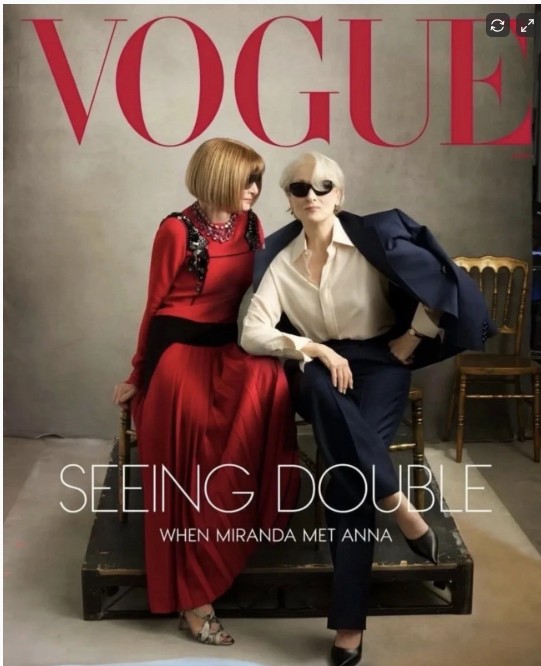
Anna Wintour and her Chanel sunglasses are everywhere. One would think they should be Prada. But they are Chanel on the cover of Vogue. And there’s all the publicity, online and in the papers, starring Anna and her shades, about Monday night’s Met Gala. I have met Anna several times over the years. Once when she gave a presentation at an ASME (American Society of Magazine Editors) function that I was overseeing. Someone had mixed up her slides. She was not happy. Wonder how that happened.
I met her father once, too. My husband, a British journalist who worked for the London Daily Mail, was a casual friend of his. Anna’s father was the editor of the London Evening Standard and was known as Chilly Charley Wintour. Anna’s been called Nuclear Wintour. Maybe it’s in the genes.
Charley’s wife Audrey Slaughter was the editor of a magazine for teenagers. So was I at the time we met. Private Eye, the British humor weekly always referred to her as The Flame Haired Temptress. I had red hair then, too. It was a long, long time ago.
Now most people if they had the chance to ask Anna a question would ask about fashion. Not me. I would ask her about her eyes. I can’t believe those sunglasses are just to keep her aloof and mysterious. Or even to cover wrinkles. What is it really? Cornea? Retina? Blepharitis? Glaucoma? Severe dry eyes? (But that might be too common.) I’ve read she has lousy vision, but I bet it’s more than that.
At the Oscars when she was announcing an award, she took her sunglasses off for a couple of minutes and she couldn’t keep her eyes open in the bright lights. Streisand was wearing tinted glasses, too, when she gave her salute to Redford. And think of all the old rockers with their dark shades always on. After 75, some things don’t hold up no matter how much work you have done, especially the eyes.
Of course, I’m interested because I have lousy eyes too. Always have. Wore thick glasses from 1st grade on. Hated those glasses from 1st grade on. My eyes would always get red too. From allergies in the spring and fall or pink eye infections in the winter. And worst of all I knew my eyes, when they were at peace, were probably my best feature. Big and blue. But too often big and blue and red and teary. And behind thick glasses. Can you understand my obsession? Anna, are they your obsession, too?
I have a couple of friends with bad eyes. We talk about our eyes all the time. When you are old, you do talk to your friends about your ailments. It’s called the organ recital. That’s funny but only the first couple of times you hear it. But most people are talking about aches, pains, joints, and the aftereffects of a fall. Not a constant blur. Anna, happy to listen if you want to share.
I have a friend who also wore glasses when she was young. From the time when she was three. She had Lasik surgery not once but twice. Not a good idea. Her corneas are very thin. She loves her doctor. But when she had cataract surgery, he put the wrong lenses in her eyes. He explained he was shipped the wrong lenses and had to change them. Another surgery on her thin corneas. Then she had retina problems. Again, the doctor operated. Her retina detached. He fixed it. It detached again. Maybe she should consult another doctor. At a teaching hospital. Who do I recommend? But I know cornea doctors, lid doctors, not retina doctors. And my doctors have made mistakes too.
That’s one of the problems with eyes; in case you are interested. Some doctors are experts with corneas. Some with retinas. Some with dry eyes — and everyone over 50 now has dry eyes. Remember when there were only one or two drops at the drugstore for dry eyes? Now there is half an aisle. Drops for dry eyes are the Manolos of medication. Little tiny bottles, big monthly price tags. And, in truth, nothing really helps. Anna, tell me, Vevye, Miebo or Xdemvy? Did any of them work for you?
But for a long time, I was all right. When I was 16, soon after Leonardo invented them, I got a pair of contact lenses. They were very, very new then. Very few people prescribed them. I remember I took the train from Long Island and went to an office in Manhattan, and a woman put them in my eyes, a pair of very rigid hard lenses. I had to stay in her office wearing them for an hour and come back a week later for another session. It took at least six weeks before I could take my prize, the lenses, home. I could see. My eyes were big and blue and clear. A miracle.
And that went on for years and years and years. Of course, there were a few problems. Scratched corneas that had to heal. Broken blood vessels that didn’t. Conjunctivitis now and then. And maybe putting a hard plastic disc in your eye 16 hours a day for more than 50 years might not have been the best idea.
In my 60s my eyes got drier and drier and drippy at the same time, too. I also had small cataracts. Solution: Have the cataracts removed, and then I wouldn’t need to wear my contact lenses. Great! Mistake number one. I went to what I was told was the best cataract surgeon in New York. He had his own clinic, had invented the lasers that were now used to perform cataract surgery. He was in business with his son. Oddly, he looked somewhat younger than his son. I was too trusting.
Of course, when his assistant was trying to test my eyes to find the correct lenses to order, they couldn’t come up with an answer. One would have thought he might have wondered why that was happening. Instead, he plowed ahead and sold me a pair of lenses that Medicare didn’t cover. As it turned out it didn’t matter about the lenses because simply cutting into my corneas which one must do in cataract surgery was about the worst thing anyone could have done.
Afterwards my eyes got even drier. I started getting cornea abrasions, scratches usually on my left eye, my bad eye, that hurt. Now I was going to Wilmer at Johns Hopkins, considered the second-best eye hospital in America. They keep treating and, even over treating me for dry eyes. Mistake number two. Afterwards there was a torn cornea. And nobody there, at the second-best eye hospital in America, noticed maybe something else was wrong. After months of too many steroid drops that made the pressure in my eyes skyrocket plus pain and blurring, a young doctor at Weill Cornell in New York, where I was also going, wondered if I might have a very rare disease that could be affecting my eyes and sent me to a doctor in Boston, as strange as the cataract surgeon, who was the leading –– and one of the very few — experts on such diseases.
He also had his own clinic, rather than working out of a hospital. These genius doctors inevitably have fights with the big hospitals and go out on their own to make more money and only do what they want. The strange Boston doctor, who sat too close, biopsied my eye, a worse experience than childbirth. It was the conclusive way to diagnose the disease. Afterwards, I took an Uber back to New York from Boston. Yes, it was that bad. And, of course, I have the rarest of autoimmune diseases that affect one’s eyes. So now I take lots of pills, have monthly infusions which make me feel tired for at least a week afterwards. That has been for the past few years. Things don’t get much better, but the doctor I now have is trying to assure that things won’t get worse. So, Anna, whatever you’ve got, I have empathy. I really do.
The Vogue cover story, about Meryl Streep who is also wearing sunglasses and Anna, is, of course, just a promotion for the new “The Devil Wears Prada” film. I read the story, white type on black background on my monitor screen. (By the way, if you have eye trouble, that makes reading a lot easier.) The piece was, of course, a puff job about them in fact, a powder puff job. It was written by the new editor of Vogue, who isn’t called the editor but rather the Head of Editorial Content, Vogue US. I’m sure it was a challenging assignment for her. Still, it made me want to see the movie, maybe even before it starts streaming.
In the piece, Anna says, “Age is actually an advantage,” and I agree in some ways it is.
But, Anna, I’m sure we both know even with sunglasses, Chanel or Prada, when it comes to our eyes, it really is not.

Myrna Blyth
Myrna Blyth is a New York Times bestselling author, longtime editor of Ladies' Home Journal, founder of More Magazine and recently the Editorial Director of AARP. During the pandemic, when many of us were making sourdough bread, Myrna earned a master’s from Johns Hopkins, and now at 86, is pursuing her doctorate at Georgetown. FOLLOW HER ON SUBSTACK.



Wow, that’s is quite a story and a good warning regarding paper perfect credential doctors. Sorry you have been through such a journey.