‘Boy, I Love To Work’

So what do you do when it’s over?
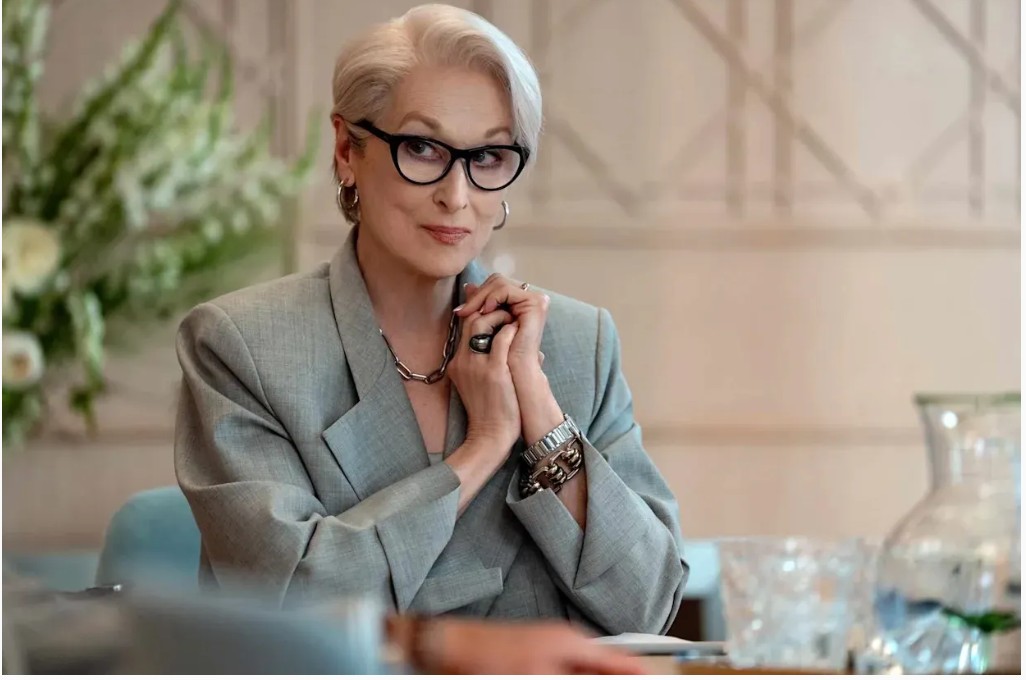
There’s a moment in The Devil Wears Prada 2 where the icy Miranda Priestly melts. She turns almost girlish, and confesses, with a grin, “Boy, I love to work, don’t you?” And there’s a previous scene when Miranda worries she may be losing her job and wonders what she will have in her life without it. Meryl Streep looks virtually the same in the movie’s new version as she did in the first, except in that scene. Suddenly she really looks older when she worries about not having the job that defines her.
Her new husband assures her she will still have “the twins” her never seen and hardly acknowledged daughters and, of course, HIM!
Nice try. Not enough.
In fact, TDWP2 is a romcom about ambitious women and the jobs they love. No leading man necessary. For the movie makes you believe that it’s work that keeps one young and happy. And that there’s more to be passionate about in the right job than in a dishy boyfriend or a caring spouse.
What else did I think of the movie? Not bad, not great. It left me with some questions and not about how long print media, even with billionaire backers, can survive. I think I know the answer to that one. Rather, I wondered why the much-lauded actor and director Sir Kenneth Branagh took the hardly-there role of Miranda’s hubby? Why Ann Hathaway’s Andy Sachs, who’s supposed to be an award-winning investigative journalist in her 40’s, acts exactly like she did as an intern in her early 20’s? And why Meryl Streep’s neck still look so good?
But back to my main point: Even before seeing Prada I’ve been thinking a lot about work and what it means in our lives. Especially in the lives of women of a certain age. Maybe that’s because it’s exactly a year since I gave up my full-time job. I knew at the time it was the right thing to do. But, to tell you the truth, it hurt.
Trying to cope I wrote a piece for a retirement website which I called “Breaking Up is Hard to Do” about how conflicted I felt. Yes, work, getting up, going out, thinking about it all the time, had been an important part of my life for over six decades.
Of, course, when I was growing up caring about the work you would do, if you even worked at all, wasn’t expected of girls. You knew what was expected. Marriage, of course by 25 at the latest, or your mother worried, and you, I admit it, worried too. Sounds almost funny now. That’s because for women a decade younger than me, the priorities shifted and shifted fast.
Millions of Boomer women suddenly began to go to work and see work, as opportunities opened, as both a challenge and a gift. Of course, some women have always worked, had always had to work, but it was different. In just 20 or so years at the end of the last century what women expected and what was expected of them totally changed. Not only did women work in greater numbers than ever before, they also began to have reasons to love their jobs and feel empowered. They made their work a significant part of their identity.
I certainly was Boomer-like in that way, and I was very lucky. I took a journalism course in my junior year in high school and was the editor of the school newspaper by my senior year. And after that I always found great magazine jobs, where I learned and which I loved.
Now Miranda does briefly mention “there is a cost” before she goes into her “I Love To Work” refrain. And I know there was. I have the memories. I remember way back in my upward climbing days a Christmas when the kids opened presents, delighted by the haul, while I was busy editing a “bestseller bonus” excerpt for an upcoming issue of Family Circle. I had spent too much money in order to beat out the competition. Hacking away–from 90,000 words to 10,000 that I hoped would make sense to a reader. That obsessed Christmas I worked most of the day while the kids played, and my husband complained. I almost forgot to put the turkey in.
More recently and even without the family, I almost missed a tour of Pompeii. I was standing aside, talking on my cell to the office about some now-forgotten crisis. It took me half an hour to catch up with the group, somewhere near the brothel. I’ve been to Pompeii, but there are mosaics I wanted to see but missed because of that call. Pompeii only once. Crises big and small that totally absorbed me almost daily for all those years.
Maybe the worst of all: I was offered a job in another city when my husband was already sick. He had stopped wanting to go anywhere. He stayed at home, in bed, on a chair or at the computer. This job was a good one, the chance to do important things and make an impact. Who gets offered such a job at age 73? My husband told me to take it, though he knew I’d be gone from Monday to Thursday every week. I wonder now if he was testing me. Of course, I took it.
Is that enough proof of my “I Love to Work” creds? But now I keep wondering why it’s so extraordinarily hard for women when the job is over. Lately I have met dozens of women trying to cope with what to do when that happens. And many, almost frantically, try to find ways to keep working, whether they need to for the money or not. They write books. They start businesses. Both are damn hard and very frustrating to do. That may give them part of what appeals about work but usually not the paycheck or the structure or the relationship, memorably close or interestingly antagonistic, one has going to an office.
Most men watched their fathers, and their grandfathers work and then retire. It was a pattern they expected. A friend who lives in a community where there are many retirees says men when they retire handle it more quietly. They really do play golf or fish. Take courses or find time for the grandkids they never had for their own children. Have hobbies. Watch sports or watch porn. Even if their work was an important part of their identity, they always knew it was going to be over and that they’d have to handle another stage in that life.
Boomer women didn’t have that preparation. They knew they didn’t have role models for work, but they don’t have role models for retirement either. They’re so proud of what they achieved, and they should be. They had done so much more than women had ever done before. Still, I sometimes wonder if Gen X and Millennial women who have always worked and had no choice about it, will have as much trouble retiring.
Maybe it’s the real responsibility for Boomer women who have led the way to show the next generations of women how to handle the years when the job is over. How to stay self-confident and fulfilled and able to flourish in a new stage in their lives.
Now isn’t that’s a worthy challenge to take on?
God knows, I, for one, am trying.

Myrna Blyth
Myrna Blyth is a New York Times bestselling author, longtime editor of Ladies' Home Journal, founder of More Magazine and recently the Editorial Director of AARP. During the pandemic, when many of us were making sourdough bread, Myrna earned a master’s from Johns Hopkins, and now at 86, is pursuing her doctorate at Georgetown. FOLLOW HER ON SUBSTACK.