Was Helen Black or White? That’s the Wrong Question.

The Real Gift of the Odyssey
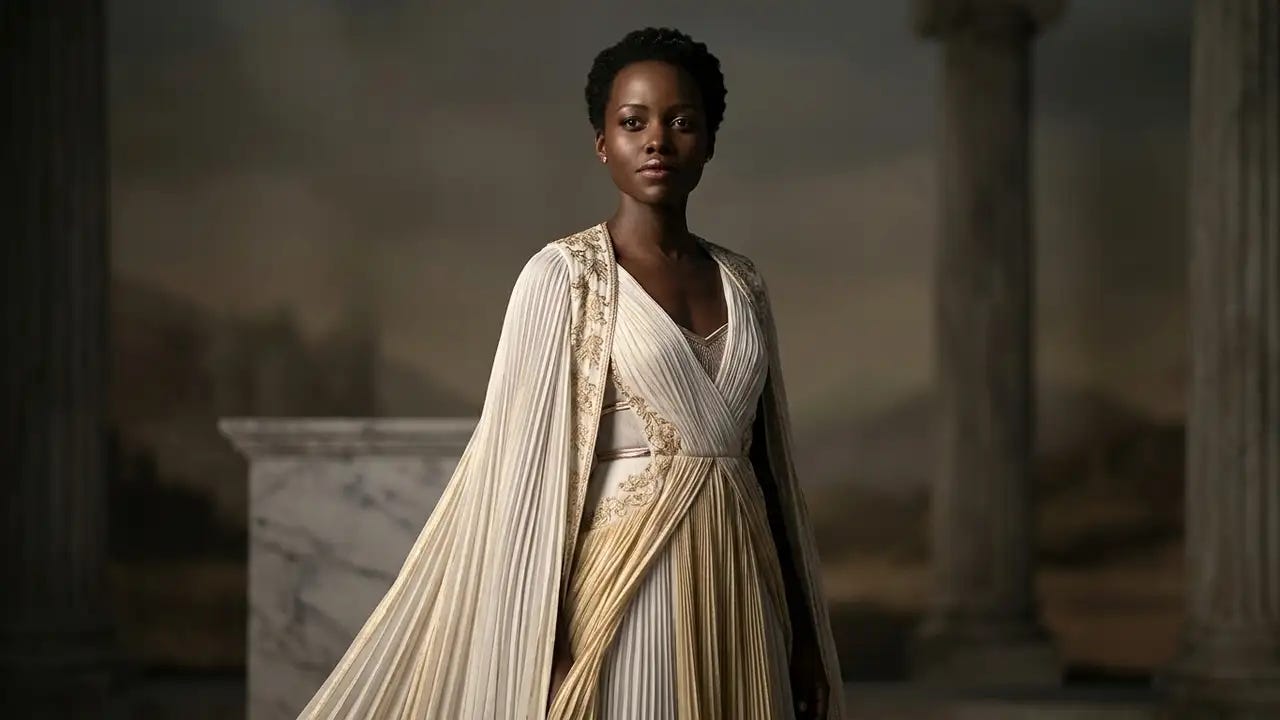
Lupita Nyong’o
The great storytellers have something important to teach us.
The question they wrestle with is not simply how to entertain us. It is how to reach us. How do you move millions of people? How do you communicate truths that audiences desperately need to hear?
My father was deeply skeptical of fiction. He believed novels were merely entertainment, pleasant diversions that distracted us from the serious business of understanding the world. One day he found me reading Jules Verne and dismissed it with a wave of his hand. “Entertainment,” he said. He believed that the great nonfiction writers deserved my attention, that history and scholarship were where wisdom lived, and everything else was entertainment.
I tried to follow his advice. I read the weighty volumes. I enjoyed a strong academic career. Yet, over time, even while working as a journalist, I came to realize something useful:
People remember great stories.
The great novelists, playwrights, filmmakers, and poets shape our culture far more deeply than statistics or scholarly arguments. Their characters become part of our moral imagination. Their stories linger in our memories long after facts have faded.
That is why I believe we often miss the real point of our greatest films.
Take The Odyssey.
Much of the public discussion has revolved around superficial questions. What color was Helen of Troy’s skin? Nobody really knows.
These debates completely miss the deeper message.
The Odyssey is not ultimately about archaeology. It is about the terrible cost of war.
It is about exhausted men watching their companions die. It is about grief, longing, fear, and the unbearable desire simply to return home.
We spend endless energy stirring arguments over identity while ignoring the suffering that conflict leaves behind. Hatred grows from these manufactured divisions, and people die while we argue.
Christopher Nolan, like the great storytellers before him, reminds us that myth can illuminate truths that academically noted history alone cannot. Whether or not every detail reflects historical reality is almost beside the point. The emotional truth remains. War destroys families, communities, and generations. That is the lesson worth carrying home.
War and its spoils should never be celebrated. They should never become objects of national pride or political theater.
We often convince ourselves that projecting military power across distant shores will somehow make us safer. Yet history repeatedly teaches the opposite. Every conflict unleashes consequences nobody predicts.
That is the journey of Odysseus.
Each new shore reveals another unexpected horror. Every apparent victory opens the door to another tragedy. The farther Odysseus travels, the more desperately he longs for the simple gift of home.
Our own century tells the same story.
Actions that once seemed decisive and victorious create new dangers we never imagined. Small waterways thousands of miles away suddenly determine the cost of food across Africa, Europe, Asia, and the Americas. Local conflicts ripple through the entire global economy. We continue discovering consequences long after the first bomb falls.
The storytellers warned us.
They remind us that home is sacred.
Odysseus does not dream of conquering another kingdom. He dreams of returning to his wife, his son, and his homeland. His deepest victory is not military triumph. It is peace.
The longing for home is universal, and the longing for peace is universal.
Somehow we continually manufacture the longing for war.
Before The Odyssey began in the theater, I watched a promotional film celebrating the newly named Department of War. As I sat there, I found myself wondering why our language itself still centers on war.
Of course, every nation has the responsibility to defend its people against genuine threats. Defense is necessary. Protection is necessary.
But effective defense and waging war are not the same thing.
A society organized primarily around preparing for war risks forgetting that its highest purpose and perhaps its greatest defense is preserving peace.
I think our greatest storytellers understand this better than some of our political leaders today.
Consider the recent film Project Hail Mary. At its heart is not a story about superior weapons or technological dominance. Survival comes through curiosity. It comes through the willingness to know the stranger instead of fearing the stranger. The hero survives because he chooses understanding over suspicion.
In my view, that too is a message of peace.
Christopher Nolan and Steven Spielberg understand something that many critics overlook. They create films on an epic scale. They are visually spectacular, emotionally gripping, and enormously entertaining. Audiences come for the adventure, the suspense, the astonishing imagery, and the technical brilliance. Yet beneath the spectacle lies something far more enduring.
The entertainment is the invitation. The gift is inside the box:
Like the prize hidden inside the old boxes of Cracker Jack, you do not get the gift the moment you open the package. You discover it only after you have worked your way through the experience. Christopher Nolan and Steven Spielberg understand this. They invite us with breathtaking spectacle, unforgettable characters, and cinematic wonder. But hidden within the adventure is something far more lasting: a deeper understanding of ourselves, of one another, and of the enduring value of peace.
The greatest storytellers know that wisdom is rarely delivered as a lecture. It is wrapped in adventure, concealed within conflict, and carried by characters we come to love. Long before there were textbooks or universities, there were storytellers like the African griot who passed stories from generation to generation. Storytelling around campfires, in ancient amphitheaters, and now on screens has affected our understanding of courage, sacrifice, compassion, prejudice, and hope.
Scholars who study the Iliad and the Odyssey debate whether or not these were written by Homer or a collection of poets and ancient storytellers. Perhaps the collection of all these instead of one man lends to the universality of the writing.
Perhaps stories endure because they quietly succeed where academic arguments so often fail. They do not demand that we change our minds. They seep below our skin and invite us to change our hearts.
And if we are willing to work our way through the whole box, we may leave the theater carrying something far more valuable than we ever expected.
_________________
Author’s side note:
As a little girl, I remember the headlines that suggested Marilyn Monroe was the most beautiful woman in the world. I believed it and took it to heart. I love that Christopher Nolan chose one of today’s beautiful women: Lupita Nyong’o as Helen, “The face that launched a thousand ships.” Now it’s the face that launched a billion tweets. Good marketing, Christopher Nolan!

Phyllis Haynes
Phyllis Haynes, Producer Haynes Media Works, Writer, Speaker Producer and Host, Profonde.TV, Princeton Television Producer, Possible Futures. She is a 25-year on-air broadcast veteran in network news and public affairs reporting. She served as the host of "Straight Talk" for WOR-TV and reported on major issues for ABC Evening News with Peter Jennings and the number one morning show Good Morning America. She received awards for her original independent documentary work. The Daily News heralded her independent production of Aids: The Facts of Life featuring Susan Sarandon as a great learning tool. Her documentary received an award from the American Film Institute and Billboard magazine.