

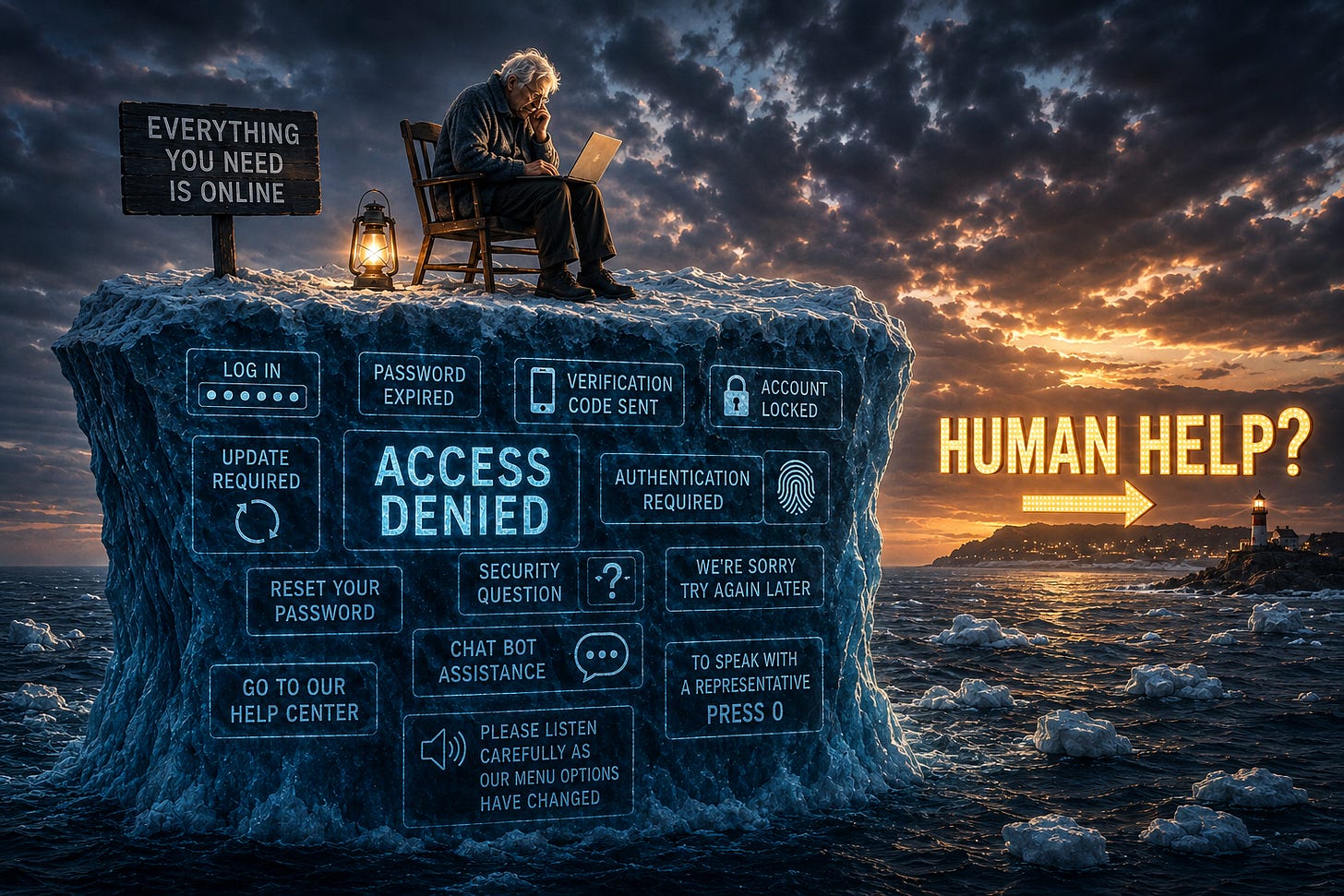
For so many, technology has become the gatekeeper to ordinary life. Being locked out can feel like a form of imprisonment.
I was recently trying to help a very sharp 80 year old man who could not get into his computer. He could not access his email, Microsoft Word, or old passwords. Somewhere in the confusion, someone had sold him a “lifetime” copy of Microsoft Word. Think about that for a moment. Here was an intelligent, capable man who had been persuaded to buy permanent access to software inside a machine he could not access at all.
At first there is something almost comical about it, the kind of technological absurdity we have all learned to laugh about. Then you look at the person sitting there, staring at the screen, and you realize it isn’t funny at all. He didn’t know what had happened. He didn’t know what he had purchased. Most disturbing of all, he didn’t know where to go for help.
That is the part that has stayed with me.
I have begun to wonder whether we are creating a kind of forced helplessness for millions of older people. We are steadily moving the necessities of ordinary life behind gleaming digital walls and then acting surprised when some people cannot climb them. There is an old and brutal image of elderly people being placed on an iceberg and pushed out to sea when they were no longer considered useful. Whether history or myth, the image is chilling because it represents abandonment disguised as inevitability.
I sometimes think we are creating a twenty first century version of that iceberg.
This one has passwords.
The older person is pushed out onto a cold digital landscape and told that everything needed for daily life is right there. The bills, the bank, the doctor, the television, the insurance company, the pharmacy, the airline reservation, the photographs of the grandchildren. Everything is supposedly within reach. There is only one problem. You have to know how to get in.
You try to pay a bill and discover that you need an online account. You try to make a medical appointment and are directed to a patient portal. The portal requires a password you created three years ago and have long forgotten. You ask for a new password, but the verification code is sent to a phone number you no longer have. You try to get a refund and are directed to an online form. Your television suddenly stops recognizing a subscription you have paid for every month, and a message appears telling you to scan a QR code.
Somewhere in this maddening maze sits a human being who may have successfully navigated eight decades of life and is now completely defeated by a six digit number flashing briefly on a screen.
So you call for help.
“Please listen carefully because our menu options have changed.”
Of course they have.
Everything has changed. Again.
You work your way through the artificial voice, answering questions and pressing numbers, until finally you believe you are about to reach an actual person. Instead you are directed to a website, where a cheerful little box pops up asking how it can help you today. You type your problem into the box. The machine misunderstands. You try different words. The machine apologizes with impeccable digital politeness and misunderstands again.
There comes a moment in this process when frustration turns into something else. It becomes helplessness.
That distinction is important.
When you cannot get into your bank account, your medical portal, your email or your own computer, you are not simply experiencing an irritating technical problem. You have lost control over a piece of your life. Someone or something has the key, and you don’t know who has it or where to find them.
There is a peculiar kind of imprisonment in that. The walls are invisible, but they are very real. Your money may be behind those walls. Your medical information may be there. Your photographs, documents, correspondence and memories may be there. The machine itself may be sitting three feet away on a familiar desk in your own home. You bought it. You own it. You can touch it.
But you cannot enter.
Imagine how that feels.
Now imagine being 82 or 87, perhaps living alone, when the telephone rings and a pleasant, patient voice says, “I understand you’re having trouble with your computer.”
Suddenly, after hours or perhaps days of frustration, there is a human being.
A warm voice. A patient voice. Someone who seems to understand. Someone who doesn’t rush you or make you feel foolish. Someone who says the most seductive words imaginable at that moment: “Don’t worry. I can fix this for you.”
And there it is.
We wonder why older people fall victim to scams. Perhaps we should spend more time examining the desperate environment in which the scammer arrives.
The scammer has discovered something many legitimate companies seem to have forgotten. A frightened and confused human being wants another human being.
We have closed so many doors to legitimate human assistance that the person who knocks politely on the wrong door can suddenly seem like a rescuer. The scammer offers patience where the corporation offers menus. The scammer offers reassurance where the website offers error messages. The scammer says, “I’ll stay with you,” while the legitimate company tells you that your session has expired.
There is an even darker irony. We have created legitimate digital communication that increasingly looks like fraud, while sophisticated fraud increasingly looks legitimate. Banks send security alerts. So do scammers. Microsoft may tell you there is a problem with your account. So does the scammer. Real companies send links and verification codes and ask you to confirm your identity. So do criminals.
Then we offer the older person the wonderfully useless advice, “Don’t click on anything suspicious.”
What exactly does suspicious look like anymore?
I am troubled by the casual way we dismiss this problem by saying that older people are simply “bad with technology.” There is something condescending and profoundly inaccurate in that phrase. It conveniently places the failure on the person instead of examining the system that failed them.
These are people who have navigated entire lives filled with complexities far greater than a computer screen. They have raised families, built businesses, practiced medicine, taught generations of children, managed households, fought wars, created art, survived grief, bought homes, cared for aging parents and adapted to breathtaking social change. They have moved through a world that went from rotary telephones and handwritten letters to smartphones and artificial intelligence in a single lifetime.
They are not stupid because they cannot find the verification code.
Many of them learned technology perfectly well. Then, just as they became comfortable, we changed it. The familiar button moved. The operating system updated itself overnight. The program they once bought became a subscription. The website was redesigned. Password requirements became more elaborate. Security questions appeared. Authentication apps arrived. QR codes became ubiquitous. A device began demanding confirmation from another device.
Yesterday’s competence can become today’s confusion without the person having done anything wrong.
And while all of this was happening, something else quietly disappeared.
The human being.
There was once a person behind the counter who knew your name. There was a bank manager whose office had a door you could walk through. There was a receptionist at the doctor’s office who would help you fill out the form. There was a customer service representative who answered the telephone and listened while you explained a complicated problem in your own imperfect words.
Increasingly, those people have been replaced by systems designed in the name of efficiency. We celebrate how much time and money companies save through automation without talking nearly enough about where the work went.
It didn’t disappear.
Much of it was transferred to the customer.
And the older customer often pays the highest price, not simply in wasted hours but in something more precious. Confidence begins to erode. Independence becomes fragile. The world that once seemed navigable starts to feel treacherous.
You begin to hear sentences like, “I’ll wait until my daughter comes over,” or “I don’t want to touch anything because I might make it worse.” Eventually, perhaps, “I guess I just won’t use it anymore.”
Those sentences should frighten us.
They describe a human world getting smaller.
Technological exclusion can quietly become social exclusion. When banking, medicine, entertainment, transportation, government services and ordinary communication migrate behind digital gates, the person who cannot navigate those gates doesn’t merely lose convenience. Slowly and almost invisibly, that person can begin to lose independence.
There is a word we don’t use nearly enough when discussing technology.
Dignity.
Human dignity includes the ability to move through ordinary life without constantly having to beg someone younger, faster or more technologically fluent to unlock it for you. There is something deeply diminishing about having to hand over control of your finances, your medical information or your personal communications simply because someone redesigned an application.
I love technology. I am fascinated by artificial intelligence and exhilarated by some of the possibilities opening before us. I don’t want to stop technological progress. I want us to become sophisticated enough to ask a harder question about what progress actually means.
Perhaps every company creating a digital service should sit an intelligent 80 year old in front of it and watch what happens. Ask that person to get into an account, find a bill, change a password, request a refund and, when something inevitably goes wrong, locate a living human being who can help.
Then the designers should remain silent.
No helpful hints. No pointing at the screen. No impatient little “It’s right there.”
Just watch.
Watch the shoulders tighten. Watch the hesitation before clicking an unfamiliar button. Watch the fear of making an irreversible mistake. Watch the frustration slowly become embarrassment and the embarrassment become surrender.
Then redesign the system.
Because the real test of advanced technology cannot simply be whether technologically sophisticated people can use it. Of course they can.
The test is whether human beings can use it.
We are rushing toward an extraordinary technological future, and I want to be part of that journey. I want to see where artificial intelligence takes us, what new forms of creativity emerge and what previously impossible problems we may finally solve.
But as we race forward, I keep looking back.
I can see people standing on the iceberg.
They are surrounded by extraordinary technology, connected to everything and somehow unable to reach anyone. The shore is still visible. The lights are still on. They can see the world continuing without them.
And before we congratulate ourselves on how brilliantly we have engineered the future, perhaps we should turn around and ask the most important technological question of all.
Who did we leave behind?



Absolutely brilliant! So true, so sad, so thought provoking and so well written!
Thank you Phyllis.
Many blessings,
Barbara Davis