Why More Isn’t Better

Striving to do more, have more, or be more might sound like a good idea, and a path to success, but it can also be a recipe for frustration and despair. Let’s take a look at four very good reasons why more will leave you high and dry—and what to aim for instead.
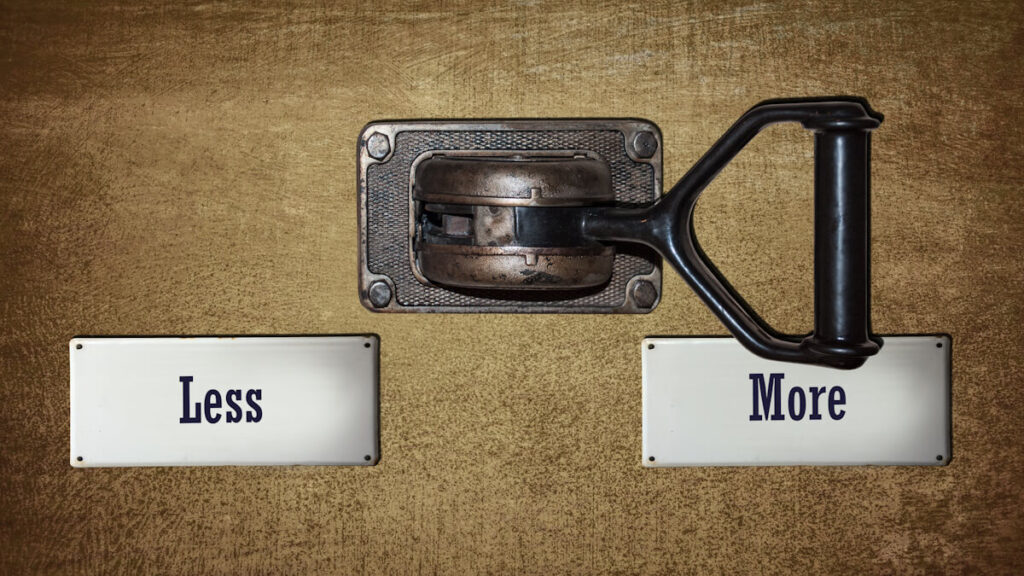
No matter what you’re doing, do you ever think you could be doing…more?
You could be… working more. Or, networking or working out more (omg why so much work!). You could be eating more vegetables. Sleeping more. Posting more. Getting more stuff done.
More is a dangerous word and a slippery slope. Why? Because you never check off a box for “more.” It. Never. Ends.
This isn’t just about having “too much” to do, or too many options. The real issue here is the underlying and persistent belief that if we don’t do more of everything — work faster, be more productive — we have failed.
The idea of more is not in itself negative; it’s the pressure around it, and ensuing guilt and shame — which is what happens when you set an impossible goal and then berate yourself for not achieving it.
In the introduction to their (hilarious) book, How to Stay Productive When the World Is Ending, the writers of the satire magazine Reductress say:
“If you were born somewhere between when wide-leg jeans were cool and when wide-leg jeans were cool again, you were probably told that if you work hard enough, you can achieve your wildest dreams. All you had to do was work hard enough to get into college, and…the rest would sort of figure itself out.”
Right.
“A huge part of our culture,” they write, “believes in the myth that any failures are the result of not working hard enough.”
If we think “work harder” is the answer, we may need to ask a better question. (And rewrite the rules.).
Reasons to Stop Using “More” As a Metric of Success
1 | More as a goal is both too lofty…and too low.
It’s easy to throw “more” at something you either want to do, think about doing, or never do.
I’ve used it myself as a catchall—for things I want to do (“make more sales”), and also things I don’t want to do (“post more stories”).
Saying “I should work out more” allows me to broadcast an intention, without committing to a goal.
(Also, why are women working out so much? Didn’t you hear about that study from the Journal of the American College of Cardiology that found women need to exercise roughly half the amount of men do to reduce their risk of dying? Stop it already!)
If it’s worth doing more of, it’s worth putting real parameters around it, and being able to make a clear and solid case for it.
If you see “more” as synonymous with improvement, you risk seeing yourself and your contributions as forever falling short.
Just aiming for “more” is never enough—not to mention it can actually decrease satisfaction. Even when it comes to something as simple as sushi.
In a profile piece for APA’s Monitor on Psychology magazine, clinical psychologist Jean Kristeller, PhD, says that because the chemical sensors in our taste buds tire quickly, “The first few bites of a food taste better than the next few bites, and after a large amount, we may have very little taste experience left at all.”
She didn’t mention sushi, but I notice this myself. I often cannot bring myself to eat that last bite of the salmon avocado roll. It’s the exact same as the first bite, but it does not taste the same, I don’t care what you say. (You want it?)
It’s worth seeing how this might play out in your own life. Would your life be that different if you did another IG story? (Mine would not.) What would doing more of “X” really give you?
And if the answer is, “Well, I don’t know, but so-and-so does it,” slow your (maki) roll.
Other people are also a lousy metric. Not only because comparison is soul crushing, but also because it’s misleading, since you have no idea what someone else has going on. I knew someone who had a 7-figure launch for her course, and I was so wowed by that…until I found out it cost her 7 figures to do it.
3 | More is stressful.
No one knows this better than productivity pro and bestselling author David Allen, whose book-turned-movement, Getting Things Done, preaches a personal approach to productivity.
“A paradox has emerged in this new millennium,” Allen writes. “People have enhanced quality of life, but at the same time they are adding to their stress levels by taking on more than they have resources to handle.”
Taking on more, of anything, may not lead to more money or power or happiness. But it likely will lead to more…stress.
And if you think having “more” passion will take care of that? Yeah, no. More doesn’t equal meaning. In fact, it can detract from it.
In a piece I wrote, “Why Passion Is No Cure for Burnout (And What to Do Instead),” I reference Joan Borysenko’s book Fried, in which she cites that those most heavily invested in their work may be likelier to burn out than those who are less attached.
Productivity pro Kerry Gleeson said, “This consistent unproductive preoccupation with all the things we have to do is the single largest consumer of time and energy.” Preach.
Allen says thinking about a thing is not the same as doing it; thinking more about it multiplies that effort times zero.
I’m not saying settle for less. But consider how the imperative to do, have, or be more dances on the knife’s edge of not-enough-ness, making it hard to feel good about where you are now—and makes it nearly impossible to do the ONE THING we need to make any kind of progress: Be present.
You Are Capable of Much, Much More — Without Having to “Do” More
I was once taken off guard at a speaking event when at the end of my talk about creating a standout brand, a dude in the audience raised his hand.
“How are you going to scale this business of yours?”
It was off topic and threw me for a loop. I ultimately begged off the question and said something dopey and evasive that was unsatisfying for both of us.
Later I had the opportunity to have lunch with Seth Godin (I know, crazy), and I told him about my awkward moment. How am I supposed to answer questions like that when I’m not trying to scale some humongous operation?
And he gave me the answer I use to this day:
“I came to a point in my business where I could do more, or I could do better, and I chose to do better.”
This is genius. Why?
Because it undermines the assumption that we should all aim to do more in an unmitigated, big-ass way. It also underscores the intention: That more isn’t better. And focused, present attention to what’s in front of you may be the very thing you need most.

Terri Trespicio
Terri Trespicio is the author of Unfollow Your Passion and founder of The New Rules Studio — a live virtual writing community where writers learn to access their ideas without the paralysis of perfectionism. Her TEDx talk "Stop Searching for Your Passion" has been viewed more than 8 million times. And she believes your next chapter starts the moment you stop waiting for permission to write it. Terri also produces and hosts Generation Artax with her two sisters Kim and Lori — a Gen X-themed podcast for the ages...the awkward ages.