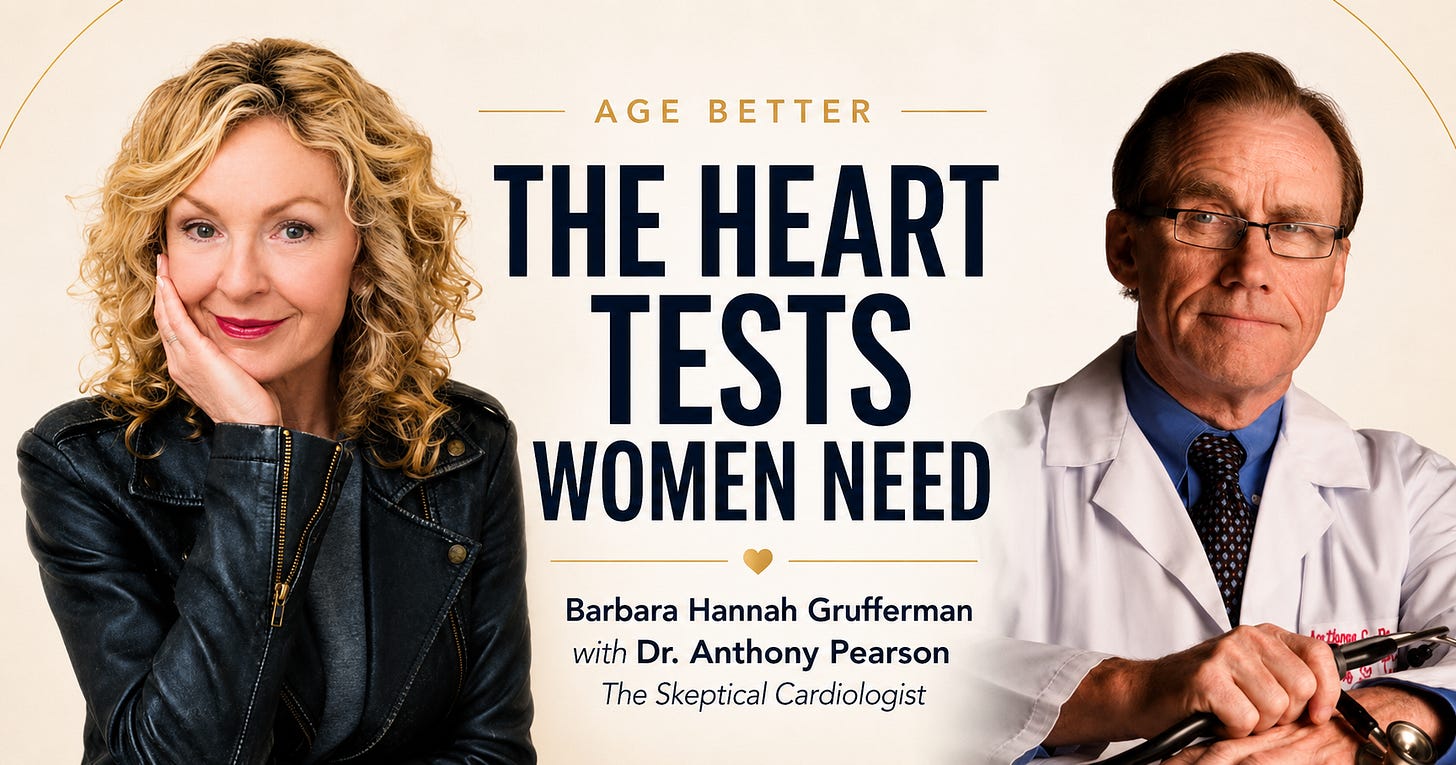
One of the things I love most about hosting AGE BETTER is that I get to ask the questions I genuinely want answered for myself.
And this week’s episode is a perfect example.
Early in our conversation, Dr. Pearson said something I loved:
“All good scientists are skeptics.”
That really set the tone for the entire episode.
Because when it comes to heart health, many of us have been taught to focus on the usual numbers, assume that exercise and a decent diet are enough, and move on. But as Dr. Pearson explains, heart disease is still the biggest killer of women, and one of the biggest blind spots is that many women still do not fully recognize their own risk.
That matters.
A lot.
Especially because, as he pointed out, atherosclerosis can build silently for years. You can be exercising, eating well, not smoking, feeling perfectly fine — and still have dangerous plaque building up in your arteries. Sometimes the first symptom is the heart attack itself.
That is exactly why this conversation felt so important.
We spent a lot of time talking about the new cholesterol guidelines, which were released in March 2026, and why Dr. Pearson believes they move much closer to a smarter, more aggressive approach to prevention. He talked about earlier detection, lifelong risk reduction, and why waiting until someone is clearly “high risk” may be waiting too long.
And of course, we got into three tests I have been talking about on AGE BETTER for quite a while now:
- CAC, the coronary artery calcium scan
- Lp(a), the inherited risk marker that should be checked at least once in your lifetime
- ApoB, which can give a clearer picture of cardiovascular risk than the standard lipid panel alone
What made me especially happy is that Dr. Pearson strongly validated the importance of all three. In fact, he said to me, “Kudos to you for being on the cutting edge there with respect to those three factors.”
I will admit it: I loved hearing that.
Because I really have been urging my listeners to ask for these tests. I’ve had them myself. I’ve talked about them on the podcast, in my newsletter, and on social media. And now, finally, the mainstream guidelines are giving them more attention too.
A few highlights from our conversation:
- CAC matters because it lets you actually see evidence of disease, not just a surrogate marker like cholesterol.
- Lp(a) matters because it is inherited, raises risk significantly, and can affect not just you, but your children and siblings too.
- ApoB matters because it is a better measure of the particles that actually drive plaque buildup.
- High-sensitivity CRP can add useful information about inflammation.
- Statins, despite all the noise around them, remain one of the most studied, effective, and affordable tools we have for reducing risk.
I also appreciated how practical Dr. Pearson was. He did not oversell. He did not hype. He did not pretend there is one perfect answer for every person.
That is part of what made this conversation so good.
He talked about nuance. About listening to patients. About the reality that some doctors do not have enough time to have these conversations well. About the importance of self-advocacy. And yes — he even said that if your doctor gets angry when you ask about these tests, you may need a different doctor.
Music to my ears.
And then, importantly, we ended where I always want these conversations to end: with what we can do every day.
Dr. Pearson’s basics were refreshingly straightforward:
- Get regular cardio exercise
- Do resistance training, especially as you get older
- Pay attention to visceral fat and body composition
- Don’t underestimate the power of lifestyle, even while recognizing that lifestyle alone is not always enough
That’s the message I want all of us to keep hearing.
Not fear. Not perfection. Not overwhelm.
Just better information. Earlier action. Smarter questions. A clearer picture of what is actually going on inside our bodies.
If you have ever been told your numbers are “fine” but wondered whether that is really the whole story, I hope you will listen to this episode.
It is one of those conversations that may truly change how you think about your heart health.
Deep Dive:
Listen to the full episode of AGE BETTER with Dr. Anthony Pearson HERE
Check out The Skeptical Cardiologist on Substack HERE