Fit But Frail? Why Function May Matter More Than Fitness to Age Better

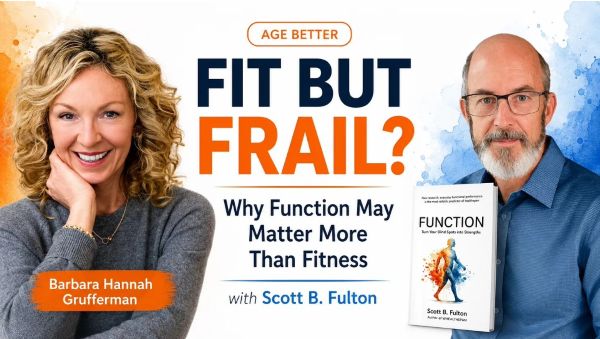
Scott B. Fulton explains why how well you function in everyday life may tell you more about how well you’re aging than how “fit” you are.
Full disclosure: one of my biggest fears is frailty. By ‘frailty’ I mean that physical and emotional limitations will start to make my world shrink. I might stop doing things I love to do. I might stop seeing people, traveling, enjoying life . . . as I get older.
I do not want to become frail.
And that’s why I was so intrigued by this book, FUNCTION, and why I invited the author to join me on my podcast, AGE BETTER.
I think a lot of us assume that if we exercise regularly, get our steps in, and try to stay strong, we’re doing what we need to do to age well.
And yes, that matters.
But my conversation with Scott B. Fulton for this week’s episode of AGE BETTER made me think about this in a very different way.
LISTEN TO THE FULL CONVERSATION BELOW.
One of the most memorable lines from our conversation was this:
“Fitness can coexist with frailty. Function can not.”
That really stopped me.
Because it means you can be active, committed, and even look fit from the outside, while still have important weak links that may affect your future mobility, resilience, and independence.
Scott calls these blind spots.
What makes his book especially useful is that it does not just explain the concept — it helps you apply it. Function includes simple, easy-to-follow self-assessments you can do at home to get a clearer picture of how you are doing right now. These tests are designed to help you spot where you’re strong, where you may be vulnerable, and how you compare with others in your age group. Even better, they’re backed by more than 50 years of data involving hundreds of thousands of people.
Another thing that really struck me is that as far as I know, Scott is the first person to think it was a good idea to bring all these ‘functional fitness tests’ together in one place, in one book.
Scott focuses on five key areas of function: strength, power, mobility, flexibility, and neuromotor function, which includes things like balance, reaction time, and cognition. His point is that weakness in just one of these areas can become a problem later, especially if we’re not paying attention to it now.
That’s why this conversation is so important.
This isn’t about looking fit. It’s about being able to live well.
Can you climb stairs confidently?
Catch yourself if you trip?
Get up from the floor?
Move through daily life with strength, steadiness, and confidence?
That is what function is really about.
We also talk about functional age versus chronological age, why falls can be so life-changing, and how simple self-assessments can help you see where you’re strong and where you may need to improve.
What I especially like about Scott’s approach is that it’s not discouraging. It’s empowering.
Once you know your weak links, you can work on them.
And that’s what aging better is all about.
If you want to stay mobile, capable, strong, and independent for as long as possible, I hope you’ll listen to this episode of AGE BETTER or watch it on YouTube.
I think it may change the way you define health.

Barbara Hannah Grufferman
Barbara Hannah Grufferman is a leading voice for positive aging. She’s an award-winning writer and speaker, a frequent guest on national television and radio shows, and travels around the country giving talks about health, fitness, sex, style and small steps we can all take to live better, longer, happier lives.