Because It’s Good

Mrs. Billingsley, a favorite teacher in high school, bucking the anticipated argument about relevancy, liked to promote the classics.
Like a mantra, she’d repeat, “It’s not good because it’s old. It’s old because it’s good.”
Not normally a yard sale gal, as I took my dog for a walk on a recent Sunday morning, I found it impossible to avoid the annual neighborhood sale. With well over a hundred households in several adjoining blocks participating, it’s become quite an annual event.
We walked past sidewalks, entryways, open garages and alleys overflowing with old books, outgrown clothes, dime store jewelry and working but obsolete electronics.
My neighbors were ready for commerce. Some homeowners confessed to me that, in past years, they brought in over five hundred dollars for the day.
It was still early in the day and the residents/vendors were just putting out their wares, tagging prices on some items, enjoying a mug of coffee brought out from their nearby kitchen.
I quickly scanned books and bric-a-brac on one metal table and took more time looking at an odd gallery of music related posters on folding chairs behind the table.
The homeowner, like me, was in his sixties. We smiled at each other when we recognized we shared similar tastes in music. Of course, we grew up with the Beatles and the Stones, some members, into their eighties, still tour. But it was clear, we were both deeply affected by the jazz greats.
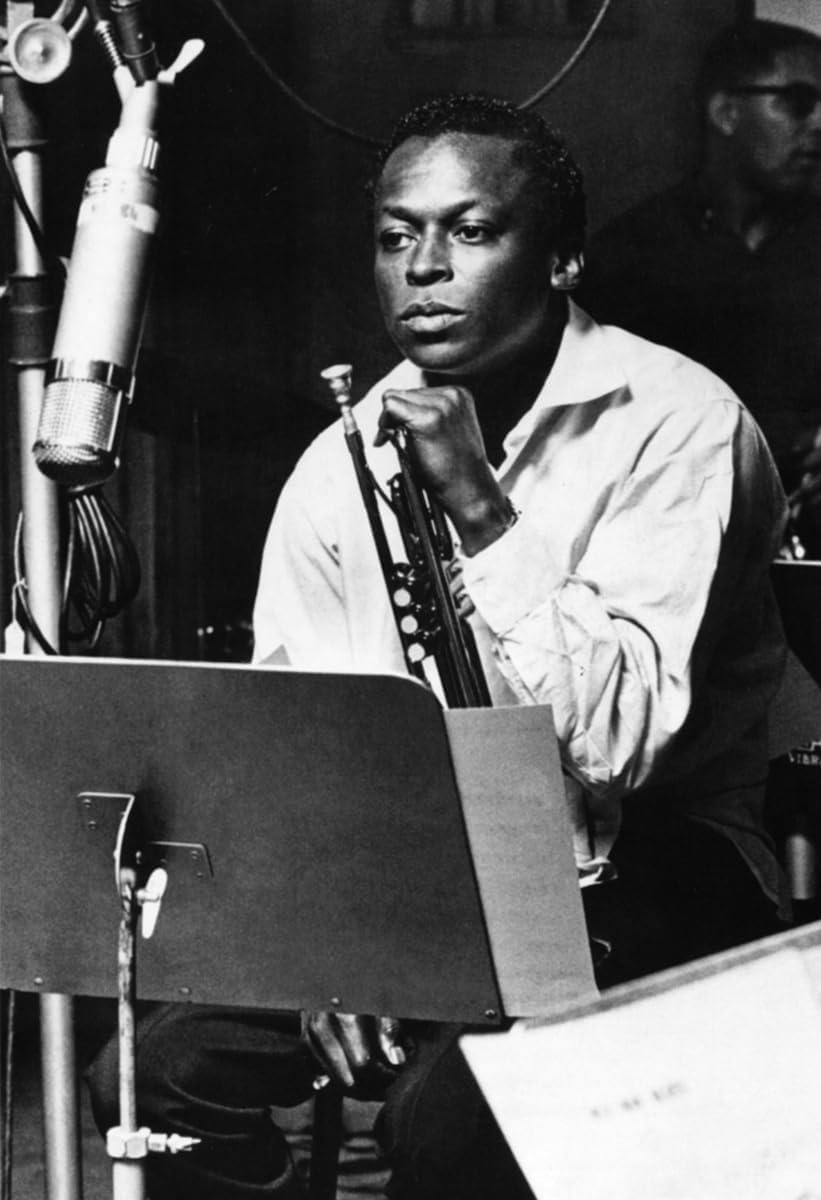
My eyes settled on a poster of Miles Davis. Cheaply framed in black plastic and covered with Plexiglas, it sported a small yellow label in the top right corner identifying the modest asking price of five bucks.
It was a promotional photo for “Kind of Blue,” which came out in 1959, only a few years after I was born. It became one of the biggest selling jazz albums of all time.
The image showed the thirtyish musician sitting wistfully on a stool in a practice room. He’s cradling his head in one palm, holding his horn with his other hand. A musical score is open on a stand next to him and a grand piano is nearby.
He looks small. Humble or burdened? I couldn’t tell. Lost in thought. Far from the image of a music legend. Oh, so human.
Did he know he was changing the world?
Born near St. Louis, he went to the Big Apple to study music at Julliard. A friend of his father’s gave him his first trumpet when he was nine. He dropped out of Julliard and started his education in bebop under the tutelage of Charlie Parker. He played with Parker’s quintet in the ‘40s.
His career spanned decades. Ever the innovator, still always respectful of the artists and traditions that went before, he played with Bill Evans, Herbie Hancock, Wayne Shorter, and many other greats. He recorded under many labels and was popular in other continents.
Innovative and brave about many professional choices, he suffered from depression, heroin addiction and even his history as a frequent domestic abuser.
The purity of his desire to take music forward along with his self-doubt and loneliness — came through in the Kind of Blue poster image.
I took India home, six blocks away, stuffed my pockets with some currency then drove my car as close as I could to the alley where I saw the poster. More neighbors were milling about although it was still before ten o’clock when I found my way back to the metal table.
The man who lived in the adjacent house said, “I was hoping you’d come back. If someone stopped here, ready to buy, I’d have to take his money.”
I smiled as I carried the framed poster to my nearby, but illegally parked, car.
Being any kind of artist wanting to be a good person, too, is no small thing.
Re-printed with permission.
Follow on Facebook; Instagram; LinkedIn

Deborah Hawkins has been blogging on gratitude and mindfulness for over a decade, posting over 500 essays. In December of 2019, she brought out two books, The Best of No Small Thing — Mindful Meditations, a collection of favorite blogs, and Practice Gratitude: Transform Your Life — Making the Uplifting Experience of Gratitude Intentional, a workbook on her process. Through her books, classes, and coaching, she teaches people how to identify things to be grateful for in everyday experiences.
Visit Deborah at: Visit No Small Thing